
ICICLE: Food Supply Networks and AI – A Four Part Webinar Series * WEBINAR III *
Direct Link: https://cias.wisc.edu/news/food-supply-networks-and-ai-a-four-webinar-series/
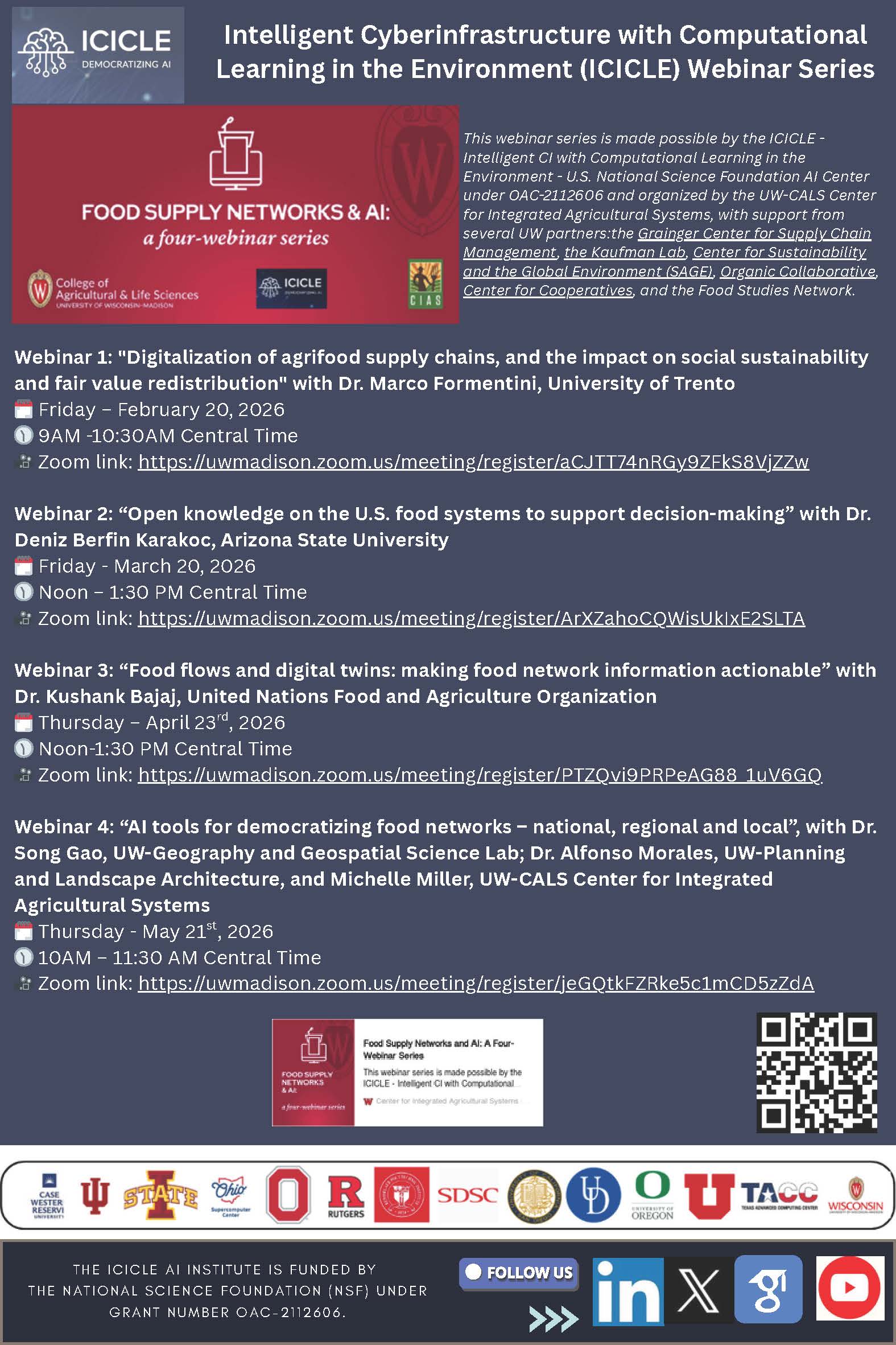
Webinar 3: “Food flows and digital twins: making food network information actionable” with Dr. Kushank Bajaj, United Nations Food and Agriculture Organization
- Thursday, April 23, 2026
- Noon-1:30PM Central Time
- Zoom link: https://uwmadison.zoom.us/meeting/register/PTZQvi9PRPeAG88_1uV6GQ
Abstract: Ensuring global food security is increasingly challenging as climate change, geopolitical disruptions, and resource constraints place growing stress on food systems. To respond effectively, we need a much clearer picture of where food is produced, how it moves through supply chains, and where vulnerabilities emerge along the way.
In this talk, Kushank will share two projects that aim to make food flows more visible and actionable. The first is Canada Food Flows, a data product and knowledge-mobilization tool that traces how fruits and vegetables move from domestic and international sources to Canadian provinces over time. The project highlights practical methods—and transparent sensitivity analyses—for estimating food flows even in data-poor contexts.
The second project is the Global Food Twin, a high-resolution, open-source modeling framework that simulates the movement of 82 food commodities across nearly 3,800 subnational regions worldwide. Developed by the Better Planet Laboratory at the University of Colorado Boulder in partnership with Earth Genome, the model combines detailed production data with fine-scale population and dietary information to estimate regional food demand. A major advance is the integration of a supply-chain module that optimizes least-cost multimodal transport—across maritime, rail, road, and inland waterways—allowing the model to simulate over 13 million distinct pathways from producers to consumers around the globe. Together, these tools offer new ways to explore exposure, resilience, and risk in an increasingly interconnected global food system.
Bio: As a Data Scientist, Kushank combines complex data with interdisciplinary methods to drive action on sustainability and systemic risk. He currently works with the UN Food and Agriculture Organization and earned his PhD from the University of British Columbia.
At the heart of his work is a commitment to making research and data more accessible, actionable, and relevant to those who need it most. He’s especially drawn to projects that are people- and policy-centered and believes that meaningful solutions to complex social problems emerge through collaboration, trust, and transdisciplinary thinking. He cares deeply about bridging the gap between research and practice. That means going beyond academic papers and technical reports to find ways of communicating insights that resonate—with policymakers, communities, and anyone trying to build a more just and sustainable world.